If you’ve shopped for 3D printer filament in 2026, you’ve probably noticed that PLA+ (sometimes written PLA Plus, PLA Pro, Tough PLA, or PLA Max depending on the brand) is everywhere. It costs the same as regular PLA, prints at the same temperature, and uses the same slicer profile — so what is the ”+” actually adding?
This guide explains what PLA+ is, how it differs from standard PLA, when each makes sense, and which PLA+ brands are worth buying.
TL;DR — the short version
PLA+ is regular PLA with toughening additives — usually a small percentage of polyurethane, polycarbonate, or other impact-modifier blended in. The result: roughly 30-50% more impact resistance than standard PLA, with everything else (printing temp, ease of use, cost) staying nearly identical.
When to buy PLA+ instead of standard PLA:
- ✅ Functional parts that take real stress
- ✅ Kids’ toys and gifts that get dropped
- ✅ Tool handles, brackets, hooks
- ✅ Anywhere “won’t break” matters
When standard PLA is fine:
- ❌ Decorative figurines (no impact)
- ❌ Vases, planters, art pieces
- ❌ Display models you’ll never touch
- ❌ Quick prototypes you’ll throw away
For most hobbyists, PLA+ is the smarter default. The price difference is usually $1-2 per kg, and the durability boost matters more often than people expect.
What “PLA+” actually means
There’s no single industry standard for what PLA+ contains — every manufacturer’s formula is slightly different. The common thread: it’s standard PLA (corn-derived polylactic acid) blended with toughening additives.
Common additives include:
- Polyurethane (TPU/PU) — adds flexibility and impact resistance, the most common modifier
- Polycarbonate (PC) — adds strength and heat resistance, used in some “Pro” formulations
- Aliphatic-aromatic copolymers — proprietary plasticizers that improve layer adhesion
- Impact modifiers — generic catch-all for various rubber-like compounds
The percentages are small — usually 5-15% of the total formula. The base material is still PLA, which is why PLA+ prints with the same temperature, the same bed prep, and the same slicer settings as standard PLA.
Each brand markets their formula slightly differently:
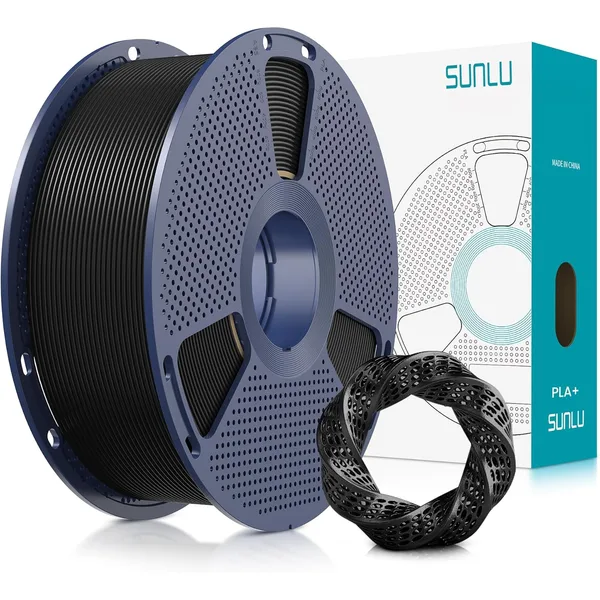
- Sunlu PLA+ — the most popular budget version, uses a polyurethane blend
- eSUN PLA+ — similar formulation, slightly higher melt temperature recommendation
- Polymaker PolyMax PLA — premium “engineering-grade” PLA with aggressive impact additives, ~9× the impact strength of standard PLA per their spec sheet
- Overture PLA+ — Amazon-popular, mid-range additive percentage
- Hatchbox Tough PLA — uses “Tough PLA” branding instead of “PLA+”, same idea
The +30-50% impact strength improvement number is approximate and varies by brand, formula, batch, and how the part is loaded. Some PLA+ products are closer to standard PLA than the marketing suggests; others (like Polymaker PolyMax) are dramatically tougher.
Side-by-side comparison
| Property | Standard PLA | PLA+ |
|---|---|---|
| Tensile strength | ~50 MPa | ~50-55 MPa (similar) |
| Impact resistance | Brittle | 30-50% more impact-resistant |
| Failure mode | Snap clean | Bend, then snap |
| Print temperature | 200-220°C | 210-225°C (slightly higher) |
| Bed temperature | 60°C | 60°C (same) |
| Heat resistance | ~60°C | ~60-65°C (slightly higher) |
| Layer adhesion | Good | Slightly better |
| Cost per kg | $15-30 | $16-32 (~$1-2 premium) |
| Slicer profile | ”PLA" | "PLA+” or “PLA” (close enough) |
The most important difference is failure mode. Standard PLA fails brittle — push a part past its limit and it snaps cleanly with no warning. PLA+ fails ductile — it bends and yields before breaking, giving you visible warning that something’s wrong.
For decorative parts that never get stressed, brittle vs ductile doesn’t matter. For functional parts that bear load, PLA+ gives you a margin of safety that pure PLA doesn’t.
When PLA+ is worth the upgrade
The question isn’t really “is PLA+ better than PLA?” (it’s marginally better at most things) but “does the marginal improvement matter for what I’m printing?”
It matters most for:
1. Things that get dropped
Kids’ toys, gaming dice towers, action figures, articulated models. PLA+ survives a fall from desk height where standard PLA might crack at the seam.
2. Tool handles and grips
Anywhere you grab the print and apply force — tool handles, drill bits, knife scales, hand-held appliance covers. PLA+ flexes enough to absorb grip pressure without cracking.
3. Hooks and brackets
Wall-mounted hooks, shelf brackets, cable organizers. PLA+ resists the slow plastic deformation (creep) that causes loaded PLA hooks to droop over weeks.
4. Snap-fit assemblies
Boxes with lids that click closed, electronics enclosures, multi-part models with snap connectors. PLA+ handles repeated snapping without the connector points crumbling.
5. Replacement parts
Anything you’re 3D-printing as a substitute for an injection-molded part — door handles, knobs, brackets, clips. PLA+ behaves more like the injection-molded original.
It matters less for:
- Vases, planters, lamp shades (no stress)
- Figurines, miniatures, models (display only)
- Cosplay props (PETG or ABS is usually better anyway)
- Calibration prints, benchies (just for testing)
How PLA+ compares to other “engineering” filaments
PLA+ sits in an interesting middle ground between standard PLA and more aggressive engineering plastics:
| Material | Impact | Heat | Print difficulty | Cost per kg |
|---|---|---|---|---|
| Standard PLA | Low | 60°C | Easy | $15-30 |
| PLA+ | Medium | 60-65°C | Easy (same as PLA) | $16-32 |
| PETG | High | 75°C | Easy-medium | $17-35 |
| ABS | High | 85°C | Hard (needs enclosure) | $20-35 |
| PC (Polycarbonate) | Very high | 110°C | Very hard | $40-80 |
| Nylon (PA) | Very high | 80°C | Hard (hygroscopic) | $30-50 |
Pattern to notice: PLA+ doesn’t quite match PETG on impact resistance or heat tolerance, but it’s much easier to print. For most “I need a slightly stronger part” use cases, PLA+ is the right balance — easier than PETG, almost as durable for most applications.
When PLA+ is NOT enough and you need to step up further:
- Heat above 65°C → PETG
- Outdoor/UV exposure → PETG or ASA
- Engineering-grade impact resistance → PETG, ABS, or polycarbonate
- Flexibility → TPU
- Continuous load (shelf brackets, weight-bearing) → PETG (PLA+ creeps over time under load)
How PLA+ prints differently
For all practical purposes, PLA+ prints identically to standard PLA. Same bed, same fan, same retraction. The minor differences:
- Print temperature — most PLA+ formulations recommend 5-10°C higher than standard PLA. Standard PLA at 210°C → PLA+ at 215-220°C. Within most slicer profiles’ tolerance.
- Bed adhesion — slightly less aggressive, which means easier release after the print but might require slightly higher first-layer squish on day 1.
- Stringing — slightly more prone to stringing because the additives reduce viscosity. Tune retraction by 0.2-0.5mm if you see oozing.
If your slicer doesn’t have a “PLA+” preset, just use the standard “PLA” preset. The differences are within the noise of normal print-to-print variance.
Best PLA+ brands in 2026
Three picks across price tiers:
Best budget: Sunlu PLA+
The most-recommended PLA+ in the hobby and the standard reference for “budget filament that doesn’t suck.” At ~$15/kg (often $12 with bundle deals), it’s the cheapest filament you can buy without compromising on diameter tolerance or color consistency. Sunlu’s polyurethane-based formula adds meaningful impact resistance over standard PLA without raising the price.
See the full breakdown in our filament cost guide and filament roundup.
Best mid-tier: eSUN PLA+
Slightly more expensive than Sunlu (~$20/kg) but with a tighter diameter tolerance and slightly more aggressive additive percentage. Comparable impact resistance, slightly better surface finish on prints, larger color palette.
Best premium: Polymaker PolyMax PLA
The “engineering-grade” PLA+. ~$35/kg for 750g spools (so ~$47/kg equivalent), with a 9× impact strength claim vs standard PLA per Polymaker’s spec sheet. Real-world testing confirms it’s significantly tougher than standard PLA+ — closer to PETG impact resistance but with PLA’s print temperature.
For most hobbyists, Sunlu PLA+ is the right answer — it covers 90% of use cases at the lowest cost. PolyMax is worth the premium only when you specifically need maximum impact resistance and PETG isn’t an option for some reason.
Calculate the cost of any PLA+ print
PLA+ is priced almost identically to standard PLA — usually within $1-2 per kg. For a typical 45g print, that’s a difference of 5-9 cents per print, which is noise compared to the durability improvement.
Use our filament cost calculator to see the exact cost-per-print for any PLA+ brand in our database. The Sunlu PLA+ entry shows $0.015/g vs Bambu PLA Basic at $0.020/g — Sunlu is actually cheaper than the standard Bambu PLA despite being a ”+” formula.
Frequently asked questions
Is PLA+ stronger than PLA?
Marginally, in tensile strength. Significantly, in impact resistance (the ability to survive sudden loads like drops). The difference is real but only matters for parts that experience impacts. For static loads, PLA+ and standard PLA are roughly equivalent.
Can I use a PLA+ profile for standard PLA, or vice versa?
Yes. The settings overlap is large enough that mixing profiles works in both directions. PLA+ at standard PLA temperatures will print, just slightly worse on layer adhesion. Standard PLA at PLA+ temperatures will print, just slightly more prone to stringing. Neither will damage your printer.
Why is PLA+ only $1-2 more than standard PLA?
The additives (polyurethane, polycarbonate) are cheaper than the base PLA, and they’re added in small percentages. The increased manufacturing cost is mostly QC and testing, not raw materials. Brands could theoretically charge more but the market wouldn’t bear it — Sunlu PLA+ at $15 is the price point that established the category.
Does PLA+ degrade more slowly than PLA?
Slightly. PLA+ tolerates moisture absorption and UV exposure marginally better than standard PLA, but both materials are still classified as “indoor only” — neither is suitable for permanent outdoor use without UV protection. For outdoor applications, use PETG, ABS, or ASA instead.
Is PLA+ food-safe?
In raw filament form, the additives in most PLA+ are food-contact-approved (the same polyurethane that goes into food packaging). But 3D printed parts of any material are not reliably food-safe because the layer lines trap bacteria and the brass nozzle leaches trace lead. PLA+ doesn’t change this. For food contact, see our PLA vs PETG guide — neither is reliably food-safe out of the box.
Is “Tough PLA” the same as PLA+?
Yes, mostly. “Tough PLA” is Hatchbox’s branding for what other companies call PLA+. The formulation is similar (PLA + toughening additives), the printing characteristics are similar, and the impact strength improvement is similar. The marketing is just different.
Should I switch all my PLA spools to PLA+?
Probably yes if you can afford the slight premium. The downside is essentially zero (PLA+ prints the same and looks the same), and the upside is meaningful for the times when a part actually gets stressed. The exception: if you print mostly decorative items (figurines, vases, art), standard PLA is fine and slightly cheaper.
Does PLA+ smell different when printing?
No. Both standard PLA and PLA+ have the same faintly sweet smell during printing — neither is unpleasant, neither is toxic at hobby quantities. ABS smells significantly worse than either.