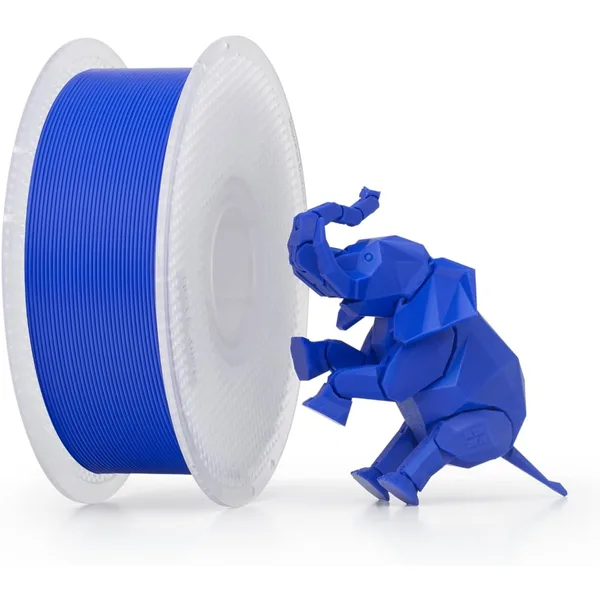
PLA and PETG are the two filaments most hobbyists pick between for 90% of prints. They cost about the same, print on the same hardware, and look similar on the spool — but they behave very differently once a part is in your hand. Pick the wrong one and your tool snaps in half on first use. Pick the right one and it lasts years.
Here’s how to choose, with no hand-waving.
TL;DR — pick this one
| Use case | Winner | Why |
|---|---|---|
| Decorative prints, figurines, props | PLA | Easier to print, sharper details, paints better |
| Functional parts that need to flex without snapping | PETG | More impact-resistant, doesn’t shatter |
| Outdoor parts, car interiors, sun exposure | PETG | PLA softens above 60°C, deforms in hot cars |
| Food contact (one-time use) | PLA | More food-safe pedigree (but read the FAQ below) |
| Brackets, hooks, mounts that hold weight | PETG | Higher impact strength, less brittle |
| Print quality / fine detail | PLA | Lower printing temp = sharper features, less stringing |
| Cost-sensitive hobby printing | PLA | $2–$5/kg cheaper than PETG on average |
| First filament you ever buy | PLA | Easiest to print, most forgiving |
The one-line answer: PLA for things that look pretty, PETG for things that take abuse.
The two filaments at a glance
PLA (Polylactic Acid)
PLA is a bioplastic made from corn starch. It’s the most-printed filament in the hobby for one reason: it just works. Low printing temperature (190–220°C), no heated bed strictly required (though one helps), no enclosure needed, almost no warping, and the printer fan can run at 100% without consequences.
The trade-offs are mechanical. PLA is brittle — a part stressed beyond its elastic limit snaps cleanly with no warning. It’s also soft when warm: above ~60°C (140°F), PLA loses structural integrity rapidly. Leave a PLA bracket in a hot car in summer and it’ll droop into a sad noodle within an hour.
PETG (Polyethylene Terephthalate Glycol)
PETG is the same family of plastic as your water bottles, modified slightly to make it 3D-printable. Higher printing temperature (230–250°C), heated bed required (70–80°C), and some printers need an enclosure for best results — though most modern printers handle it fine in open air.
PETG’s defining characteristic is impact resistance. Where PLA snaps cleanly, PETG bends, flexes, and yields. It also handles heat much better — usable up to about 75°C continuous, with brief excursions to 80°C+. You can leave a PETG part in a car and it’ll be fine.
The trade-off: PETG is stickier in the nozzle and prone to stringing if your retraction settings aren’t tuned. First-time PETG printers usually fight stringing for a few prints before dialing it in.
The seven things that actually matter
1. Strength
Both filaments have similar tensile strength on paper (~50 MPa), so neither is “stronger” in the basic sense. The difference is how they fail.
- PLA fails brittle. Push a PLA part past its limit and it cracks suddenly with no warning. Once cracked, it’s done.
- PETG fails ductile. PETG bends and yields before cracking, giving you visual warning that something’s wrong. A stressed PETG hook will start to deform a day before it actually breaks.
For static decorative parts (a vase, a figurine, a plaque), brittle vs ductile doesn’t matter — you’re not stressing them. For anything that bears load or might be dropped, PETG wins because it’s more forgiving.
Real-world test: print the same 3mm-thick L-bracket in both filaments and step on the corner. PLA snaps. PETG flexes, white-stresses, and survives.
2. Heat resistance
This is where PLA fails hard.
- PLA glass transition temp: ~60°C (140°F)
- PETG glass transition temp: ~75–80°C (167–176°F)
What “glass transition” means in practice: above this temperature, the plastic loses stiffness and starts to deform under its own weight. Stuff that gets hot enough to ruin a PLA print:
- The interior of a car parked in summer sun (easily 70–80°C / 160–175°F)
- Outdoor mounting in direct sun (PLA in Texas summer sun = 1 day to failure)
- Anything near a heat-generating device (laptop chargers, motor housings, light fixtures)
- A dishwasher (don’t put either filament in a dishwasher, but PETG handles the thermal stress better)
If a part will ever be hot, use PETG. Don’t try to “be careful” with PLA in hot environments — physics doesn’t care.
3. Outdoor / UV resistance
Neither is great, but PETG is meaningfully better.
- PLA: degrades in 6–18 months of direct sun. UV breaks down the polymer chains and the part gets brittle and chalky.
- PETG: degrades in 2–4 years. Slower than PLA but still not “forever.”
- ASA: the actual answer for outdoor parts. UV-resistant by design, lasts 10+ years.
For occasional outdoor use, PETG is fine. For permanent installation, use ASA (or PETG with a UV-resistant clear coat).
4. Print quality and detail
PLA wins decisively on fine detail, surface finish, and bridging.
- PLA prints sharper corners. Lower temperature means less heat smear, so small features stay crisp.
- PLA bridges better. With max-cooling fans, PLA can bridge gaps up to 50mm without sagging. PETG sags noticeably above 20mm.
- PLA has less stringing on tuned printers. PETG is naturally stickier and tends to ooze between travel moves.
- PLA paints and sands more easily. PETG resists most spray paints unless primed first; PLA accepts paint directly.
For figurines, miniatures, props, cosplay, and anything where the surface finish matters, PLA is the right choice. The exceptions are if you need transparency — PETG comes in actual clear filaments that print water-clear, while PLA “clear” is more like frosted glass.
5. Ease of printing (especially for beginners)
- PLA: literally the easiest filament to print. Most printers ship with PLA profiles tuned out of the box. Open-frame printers, no enclosure needed, fan at 100%, no warping concerns.
- PETG: medium difficulty. You need a heated bed, some retraction tuning to avoid stringing, and bed adhesion can be tricky (PETG can stick too well to certain bed surfaces and damage them).
If this is your first roll of filament, start with PLA. Get comfortable with bed leveling and slicer settings on the easy material before trying PETG.
6. Cost
PLA is cheaper, by a small but consistent margin:
-
Budget PLA: $15–$20 per kg (Sunlu, Overture, Elegoo)
-
Mid PLA: $20–$25 per kg (Bambu Basic, Hatchbox, PolyLite)
-
Premium PLA: $29–$37 per kg (Prusament, MatterHackers Pro)
-
Budget PETG: $17–$22 per kg
-
Mid PETG: $22–$28 per kg
-
Premium PETG: $30–$40 per kg
PETG runs roughly $2–$5 more per kilogram across every tier. For most hobby printing, that’s a $0.10–$0.20 difference per print — negligible. For high-volume sellers, it adds up to $50–$200/year depending on volume.
See our filament cost guide for brand-by-brand pricing.
7. Food safety
This is the most misunderstood comparison.
Neither is reliably food-safe out of the printer. Both PLA and PETG raw filament are made from food-contact-approved polymers, but the printing process introduces problems:
- Layer lines trap bacteria. The microscopic ridges on every 3D printed part are perfect bacterial habitats. Even with food-safe plastic, the surface isn’t.
- Brass nozzles contain lead. Standard 0.4mm brass nozzles leach trace lead during printing. For food contact, you need a stainless steel nozzle ($5–$15).
- Printer hotends accumulate residue. Whatever you’ve printed before contaminates new prints unless you do a thorough purge.
The reality:
- One-time use (a measuring spoon scoop, a pancake batter mold for a single weekend project): both are fine.
- Repeated dishwashing: PETG handles dishwasher cycles better than PLA (PLA softens at dishwasher temperatures), but neither is great.
- Hot food contact: avoid both. PLA softens at 60°C, PETG at ~75°C.
- Long-term storage: avoid both. Layer lines.
If you’re serious about 3D-printed food contact items, use food-safe certified PETG (Polymaker PolyLite PETG has food-contact certification) printed on a stainless steel nozzle, food-grade epoxy-coated for sealed surface, and treat as single-use.
When to use PLA — concrete examples
- Any decorative model from Printables, Makerworld, or Thingiverse
- Cosplay props you’ll paint
- Tabletop minis
- Phone stands, desk organizers, cable clips for indoor use
- Vases, planters (non-watering), display pieces
- Low-stress mechanical parts (nothing load-bearing)
- Christmas tree ornaments, party decor
- First filament for a new printer
When to use PETG — concrete examples
- Tool handles, screwdriver bits, anything you’ll grip hard
- Outdoor mounts (cameras, sensors, garden hardware)
- Car interior accessories (sun visor mounts, console organizers)
- Bottle openers, drink holders
- Anything that goes in a hot car or shed
- Mechanical parts that flex repeatedly (hinges, snap-fits)
- Replacement appliance knobs, handles, hooks
- 3D printer upgrade parts (Voron parts are PETG/ABS for a reason)
- Brackets that hold any meaningful weight
What to use if you can only buy one spool
Buy PLA first. Always. PLA handles the largest variety of beginner prints, prints reliably out of the box on any printer, and teaches you good fundamentals. After your first 1kg spool of PLA, then try a roll of PETG to see what the trade-offs feel like in your hand.
The order I’d recommend for new owners:
- First spool: Sunlu PLA+ or Bambu PLA Basic (budget or mid-tier PLA)
- Second spool: A different color PLA (you’ll always want options)
- Third spool: Overture PETG or Sunlu PETG (your introduction to PETG printing)
- Fourth spool: A specialty material — Silk PLA for shiny prints, or Matte PLA for organic surfaces
Between PLA and PETG, you can handle 90% of hobby printing. The other 10% (ABS, ASA, TPU, Nylon, PLA-CF) are upgrades you grow into.
How to estimate the cost of any print
Once you’ve picked PLA or PETG, our filament cost calculator handles the per-print math. Drop in your spool price and weight, enter the grams used from your slicer, and it shows you exactly what each print costs in filament. The calculator includes presets for 32 popular brands across both materials.
Frequently asked questions
Is PETG really stronger than PLA?
Slightly, on most metrics. The bigger difference is how it fails. PLA snaps clean; PETG yields and bends. For anything that takes impact or flexes, PETG is the practical answer regardless of the marginal tensile strength comparison.
Can I print PETG on the same printer as PLA?
Yes. Almost every modern 3D printer handles both materials with no hardware changes — just swap the filament and load a PETG slicer profile. The only printers that struggle are very old units without heated beds (PETG requires a heated bed; PLA can go without).
Does PETG smell bad when printing?
Less than ABS, more than PLA. PETG has a faint plasticky odor while printing — noticeable in a small room, easy to ignore in a workshop or garage. It’s not toxic at hobby quantities, but printing in a closed bedroom isn’t ideal.
Why does my PETG print look stringy?
Stringing on PETG almost always comes down to retraction settings. Increase retraction distance to 5–6mm (Bowden) or 1–2mm (direct drive), bump retraction speed to 35mm/s, and enable “wipe on retract.” If your slicer has a “stringing test” model, print one and tune from there.
Can PETG print without an enclosure?
Yes for most prints. Open-frame printers handle PETG fine — the heated bed is more important than chamber temperature for PETG specifically. Enclosures help for very large prints (bigger than ~150mm) where layer adhesion matters more.
Is “PLA+” stronger than regular PLA?
Slightly. PLA+ (sometimes called PLA Pro, Tough PLA, or PLA Max depending on brand) is regular PLA blended with toughening additives — usually a small percentage of polyurethane or similar. Real-world: PLA+ has about 30–50% better impact resistance than standard PLA but is still notably weaker than PETG. Worth the small price premium if you want to stay in the PLA ecosystem but need a bit more durability.