There are over 200 filament brands selling 3D printer filament on Amazon in 2026. About 8 of them are worth your money. The other 192 are some combination of marginal QC, missing diameter tolerance, sketchy color consistency, and brand names that didn’t exist last year and won’t exist next year.
This guide picks the 8 filaments worth buying across every major material category — budget PLA through premium specialty — based on what actually prints reliably on a stock printer with default slicer settings.
TL;DR — pick by material
| Material | Best pick | Price/kg | Why |
|---|---|---|---|
| Best budget PLA | Sunlu PLA+ | $15 | Cheapest reliable filament in the hobby |
| Best mid PLA | Bambu Lab PLA Basic | $20 | AMS RFID, default Bambu profile, wide colors |
| Best premium PLA | Polymaker PolyLite PLA | $23 | Engineering-grade QC for mid-tier price |
| Best matte PLA | Polymaker PolyTerra Matte | $23 | True matte finish that hides layer lines |
| Best PETG | Overture PETG | $22 | Tightest tolerance budget PETG, just works |
| Best ABS | eSUN ABS+ | $24 | Less warping than standard ABS, acetone-smoothable |
| Best TPU | eSUN eFlex TPU 95A | $30 | Right balance of flex and printability |
| Best Amazon all-rounder | Overture PLA | $19 | Tightest budget tolerance, biggest color range |
If you want one bottom-line recommendation: buy a 1kg roll of Sunlu PLA+ in black for your first print, and a 1kg roll of Overture PLA in whatever color you actually want for your second. That’s a $35 starter library that handles 90% of beginner prints.
How to read this guide
Filament marketing is full of nonsense. “Industrial grade!” “1.75mm ±0.01mm!” “Highest quality!” Most of it is theater. The metrics that actually matter:
- Diameter tolerance — how consistent the filament thickness is along the spool. Lower variance = more consistent extrusion = cleaner walls. Standard hobby filament is ±0.05mm; premium filament is ±0.02mm.
- Real spool weight — some manufacturers ship 850g spools at “1kg” sticker prices. Always check.
- Cost per gram — the only fair way to compare across brands. Sticker price hides spool-size shenanigans.
- Color consistency batch-to-batch — does the “true black” you bought last month match the “true black” you buy this month? Some brands are great at this, some are awful.
- Print profile compatibility — does it work with your slicer’s stock profiles, or does it need custom tuning?
Every pick below is judged on the above. We don’t care about packaging glamor shots, fancy spool design, or “lab tested!” claims with no test data published.
Best budget PLA: Sunlu PLA+
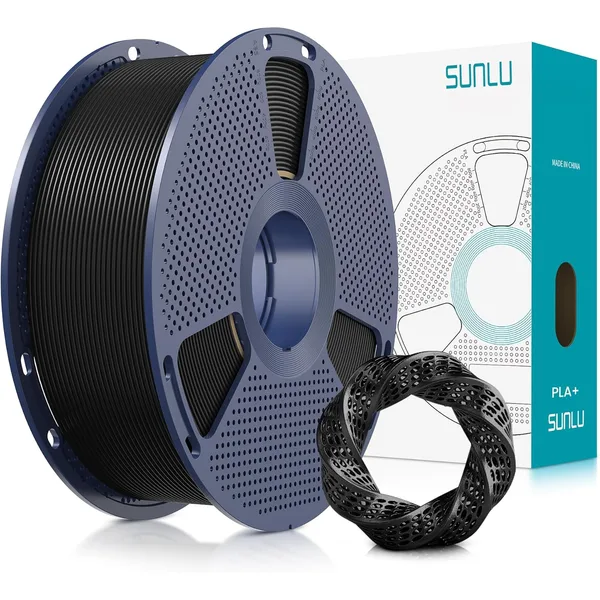
Sunlu PLA+ (1kg)
$15Sunlu · budget
The reliable budget PLA+ pick. Under $16 per spool, consistent quality, frequent bundle discounts.
- $0.015 / gram
- Dries well, prints in a wide temp range
- Huge color selection
The Sunlu PLA+ has been the default budget pick for 3D printing hobbyists for the last four years and doesn’t show signs of being unseated in 2026. At ~$15 per 1kg spool (often dropping to $12 with bundle deals), it’s the cheapest filament in the hobby that doesn’t compromise on diameter tolerance or color consistency.
What “PLA+” means here: it’s standard PLA with a small percentage of polyurethane additives that bump impact resistance roughly 30-50% above plain PLA. Real-world: a Sunlu PLA+ part will survive a drop from desk height where standard PLA cracks. It’s not engineering-grade strong, but it’s meaningfully tougher for the same price.
Why it stays the recommendation:
- Diameter tolerance is ±0.03mm at this price tier — better than half the more expensive options.
- Color selection is enormous (60+ active colors at any time on Amazon).
- Bundle deals: Sunlu regularly runs 5-for-4 promotions that drop the effective per-spool price to ~$12.
- The community knows it. Every printer profile works out of the box.
The downsides are minor: the spools are bare cardboard (not the recyclable design Polymaker uses), and the color names sometimes don’t match what you actually get (“transparent green” can vary batch to batch). For first-time buyers and bulk hobbyists, none of this matters.
Buy this for: First filament, bulk bargain stocking, kids’ projects, anything you’re going to break and replace.
Best mid PLA: Bambu Lab PLA Basic
Bambu Lab PLA Basic (1kg)
$19.99Bambu Lab · mid
Tuned for Bambu printers with matching RFID profiles. If you own a Bambu, this is the default.
- $0.020 / gram
- AMS RFID auto-recognition
- Wide color selection, reliable feed
If you own a Bambu Lab printer (A1, A1 Mini, P1S, X1C), Bambu PLA Basic is the path of least resistance. The killer feature is AMS RFID auto-recognition: drop a Bambu spool into the AMS and the printer instantly knows the material, recommended temperature, and recommended profile — no manual setup, no risk of running PETG settings on a PLA spool.
Beyond the AMS integration, Bambu PLA Basic is genuinely good filament. Tight tolerances, great color saturation, consistent batch-to-batch quality, and the dye chemistry produces especially vibrant primary colors that hobby filaments often can’t match.
Why this isn’t the universal pick:
- It’s slightly more expensive than Sunlu PLA+ ($20 vs $15).
- Outside the Bambu ecosystem, it’s just regular mid-tier PLA — the AMS RFID magic doesn’t work on Prusa or Creality printers.
- Color range, while broad, is still smaller than the Sunlu/Hatchbox combined catalog.
If you don’t own a Bambu printer, this is fine but not specifically better than other mid-tier PLA. Get the Bambu PLA when the AMS convenience matters — otherwise stick with Sunlu PLA+ or jump to the Polymaker pick below.
Buy this for: Bambu Lab printers (especially with AMS), reliable mid-tier color saturation, anyone who values the convenience of RFID auto-config.
Best premium PLA: Polymaker PolyLite PLA
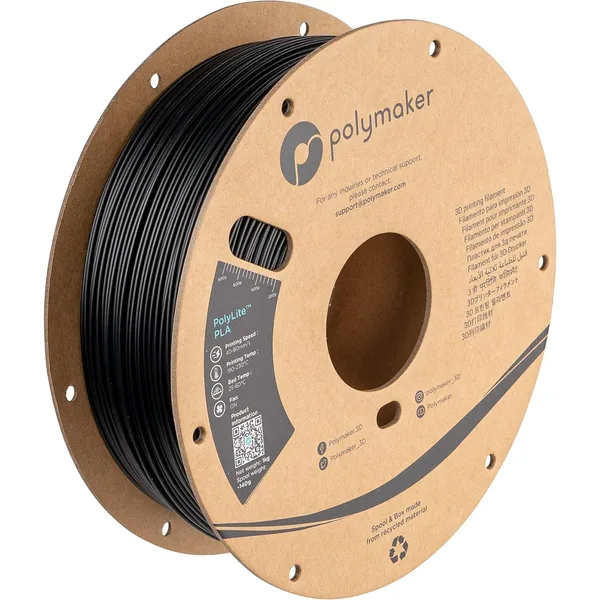
Polymaker PolyLite PLA (1kg)
$22.99Polymaker · premium
The sweet spot — near-premium consistency at mid-tier price. Polymaker has the best QC documentation in the industry.
- $0.023 / gram
- +/- 0.03 mm diameter tolerance
- Detailed batch spec sheets published
Polymaker is the most engineering-driven filament brand on the market, and PolyLite PLA is the entry into their lineup. At ~$23/kg, it costs about $5 more than mid-tier brands, and the difference shows up in consistency: tighter diameter tolerance, better batch-to-batch color matching, and the cleanest published QC documentation in the hobby (Polymaker publishes batch-level spec sheets you can look up by spool number).
What you get for the premium:
- ±0.02mm diameter tolerance vs the ±0.03mm typical of budget filaments. Matters for fine-detail prints with thin walls.
- Cleaner color saturation — Polymaker’s pigment chemistry produces deeper, more accurate colors than competitors at the same price.
- Documented batch QC — every spool carries a code that links to the production batch’s measured tolerance, weight, and humidity. You can verify your specific spool’s quality.
- Recyclable cardboard spool — Polymaker’s PolyTerra line ships on cardboard spools that are actually compostable, and PolyLite is moving in the same direction.
The honest take: for hobbyists making decorative prints, Sunlu PLA+ at $15 is “good enough.” Polymaker PolyLite is the right call when you’re printing functional parts where diameter consistency matters, doing commercial work where batch reliability matters, or just want the best mid-tier filament without paying Prusament prices.
Buy this for: Functional prints, fine-detail work, commercial sellers, anyone who got burned by inconsistent budget filament once.
Best matte PLA: Polymaker PolyTerra Matte
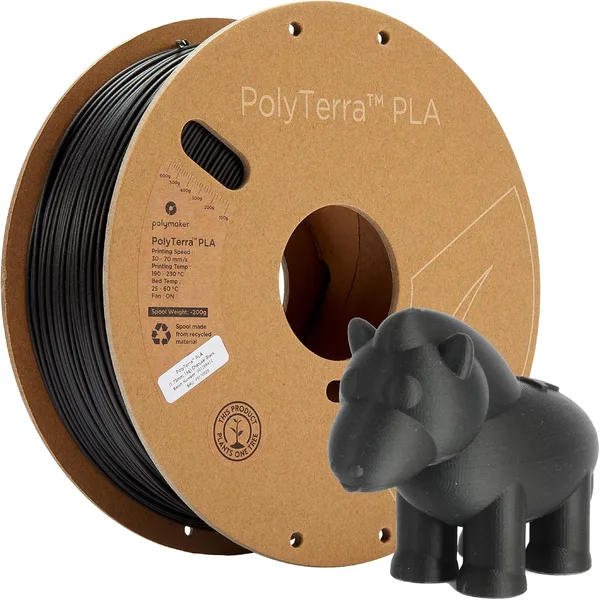
Polymaker PolyTerra Matte PLA (1kg)
$23Polymaker · mid
The matte PLA people actually rave about. Crisp matte finish hides layer lines, prints like standard PLA, recyclable cardboard spool. Comes in 30+ earth tones.
- $0.023 / gram
- True matte finish, hides layer lines
- Cardboard spool, eco-conscious
Matte PLA is having a moment in 2026, and Polymaker’s PolyTerra is the line that started it. The matte finish is genuinely matte — not “low-gloss” like cheap matte filaments — and it hides layer lines remarkably well. A part printed in matte black PolyTerra at 0.2mm layer height looks closer to injection-molded than 3D-printed.
Why matte filament matters:
- Hides layer lines without sanding or post-processing
- Doesn’t show fingerprints like glossy PLA does
- Photographs well — matte parts look professional in product photos and video
- Soft, organic look for natural-themed prints (planters, organic shapes, art pieces)
PolyTerra comes in 30+ earth tones — sage green, terracotta, forest, sand, charcoal — that play well with each other for multi-color prints. Each spool ships on a recyclable cardboard spool, which is both a real environmental win and a small annoyance because cardboard spools don’t fit some AMS systems perfectly.
It prints just like standard PLA. No special temperature, no special bed, no slicer profile changes needed. Drop it in, run a regular PLA profile, get matte parts.
Buy this for: Decorative prints, anything you’ll photograph, organic/natural aesthetic projects, art pieces, planters.
Best PETG: Overture PETG
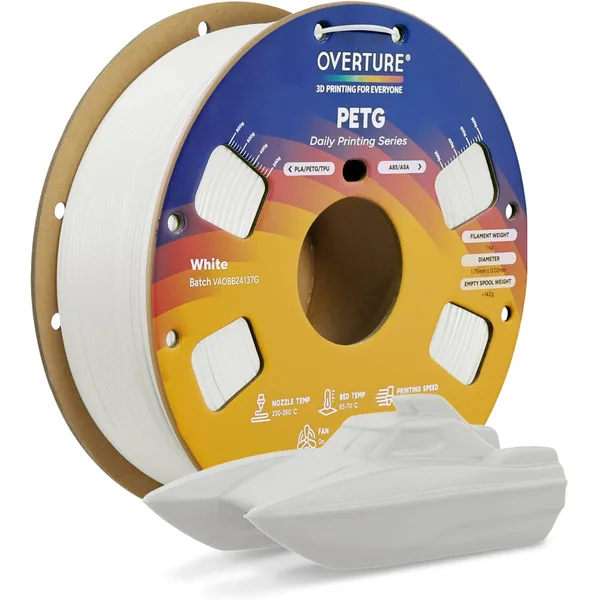
Overture PETG (1kg)
$22Overture · budget
The default budget PETG. Tighter diameter tolerance than most sub-$25 PETG, prints clean on all major slicers, no enclosure needed.
- $0.022 / gram
- Heat resistant to ~75°C
- Reliable bed adhesion on PEI
PETG is the natural step-up from PLA when you need a part that won’t snap, won’t soften in a hot car, or needs to survive outdoor exposure. Overture is the budget pick that doesn’t feel like a compromise — same parent company as their popular PLA, same tight QC, same wide color range.
At ~$22/kg, Overture PETG is roughly $3 more than Overture PLA. That’s the standard PETG premium across the entire market — every brand charges $2-5 more per kg for PETG vs PLA in the same line.
Why this beats other budget PETG:
- ±0.02mm diameter tolerance — tightest spec at this price, comparable to brands twice the price.
- Reliable bed adhesion on PEI — PETG is famously sticky on textured PEI build plates (the kind that ship with most modern printers). Overture’s surface chemistry behaves predictably.
- Stringing is manageable — every PETG strings unless you tune retraction, but Overture is on the easier end. Most stock slicer profiles produce acceptable results.
- Heat resistant to ~75°C — handles hot cars, outdoor mounting, brackets that hold hot devices.
The other PETG brand worth considering is Bambu PETG HF (high-flow), which prints faster but costs $28/kg. For most hobbyists, Overture is the smarter buy.
Buy this for: Any functional part that needs to flex without snapping, outdoor mounts, hot-environment items, your first non-PLA filament.
See PLA vs PETG for the full breakdown of when each makes sense.
Best ABS: eSUN ABS+
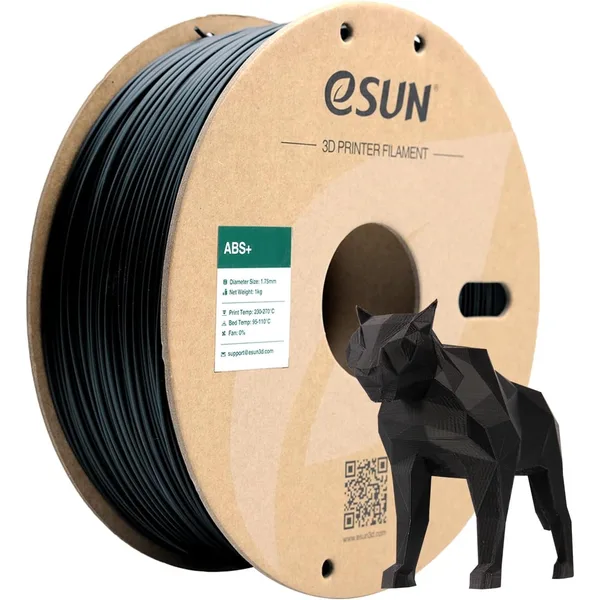
eSUN ABS+ (1kg)
$24eSUN · mid
The most reliable budget ABS on Amazon. Lower warping than standard ABS, acetone-smoothable, and stable at 80°C+ continuous use.
- $0.024 / gram
- Less warping than standard ABS
- Acetone vapor smoothable
ABS used to be the universal “engineering plastic” of 3D printing before PETG took over. In 2026, ABS still has two unique advantages over PETG: acetone vapor smoothing (which gives prints a glass-smooth finish) and higher continuous heat resistance (~85°C vs PETG’s ~75°C). Those make ABS the right pick for automotive parts, items that go in dishwashers, and anything you want to post-process to a glossy finish.
eSUN ABS+ is the most reliable budget ABS on Amazon. The ”+” designation means modified ABS with reduced warping characteristics — actual ABS warps badly without an enclosed printer, but ABS+ is meaningfully more forgiving and can be printed on many open-frame machines if you keep ambient temperature high and use a brim.
Important caveats for ABS:
- Print enclosed if possible. Open-frame printers can run ABS+ but parts will warp and may crack at layer boundaries on larger prints.
- Print on PEI or with glue stick. ABS sticks beautifully to certain build plates and not at all to others.
- Ventilation matters. ABS releases fumes during printing that smell distinctly chemical and aren’t great for closed bedrooms. Print in a workshop or garage.
- Acetone vapor smoothing is the killer feature. Drop a printed ABS part in a sealed container with acetone for 30 minutes and the surface melts smooth. PETG can’t do this.
Buy this for: Automotive parts, dishwasher-safe items, parts you want to vapor-smooth, anything that needs heat resistance past 75°C.
Best TPU: eSUN eFlex TPU 95A
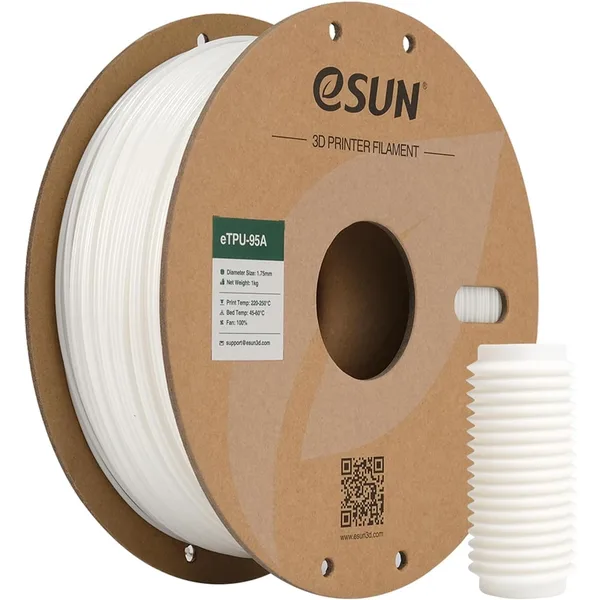
eSUN eFlex TPU 95A (1kg)
$30eSUN · mid
The standard TPU pick for hobbyists. Shore 95A flexibility — soft enough for phone cases, rigid enough to print without pressure issues on most direct-drive printers.
- $0.030 / gram
- Shore 95A — flexible but printable
- Direct-drive recommended
TPU (thermoplastic polyurethane) is flexible filament — phone case soft, basically. The “95A” in the name refers to Shore hardness — 95A is the right balance for most hobby printing: flexible enough to bend and squish, rigid enough to actually feed through your printer’s extruder without buckling.
eSUN eFlex 95A is the standard hobbyist pick because:
- It actually prints on most printers without massive tuning. Lower-Shore TPU (80A, 85A) gets buckling-difficult on Bowden setups; 95A works on most direct-drive printers and many Bowden setups.
- Layer adhesion is excellent, which matters because flexible parts get bent repeatedly and weak layer bonds fail fast.
- Stable diameter for a flexible material (flexible filaments are notoriously inconsistent because the soft material deforms during winding).
Important TPU notes:
- Direct-drive extruder strongly recommended. Bowden printers can sometimes manage 95A TPU but it’s frustrating. If you have a Bambu A1, P1S, X1C, Prusa MK4, Ender V3 KE — all direct-drive, all fine.
- Print SLOW. 25-35mm/s is the sweet spot. TPU at 200mm/s like the marketing suggests doesn’t work in real life.
- Dry your TPU before printing. TPU absorbs moisture in days. See our filament storage guide.
Buy this for: Phone cases, gaskets, vibration dampers, soft grips, anything that needs to flex repeatedly without breaking.
Best Amazon all-rounder: Overture PLA
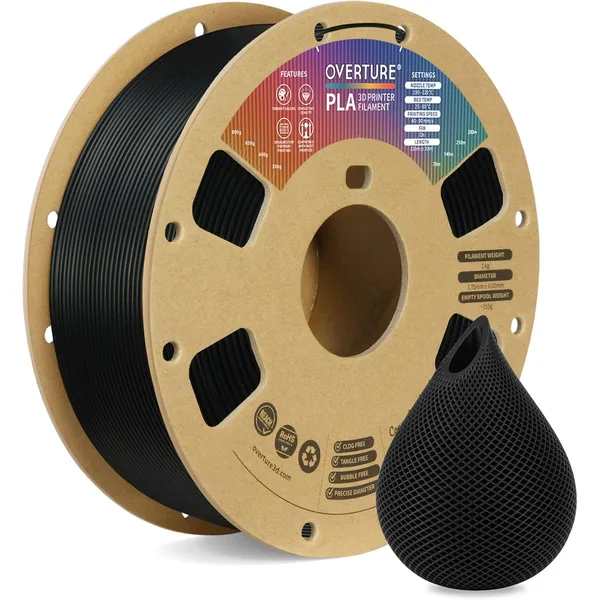
Overture PLA (1kg)
$19Overture · budget
Amazon best-seller with tight tolerances for the price. Solid step up from Sunlu if you want a bit more consistency.
- $0.019 / gram
- +/- 0.02 mm diameter tolerance
- Works out of box on all major printers
If we had to pick one PLA spool for someone who doesn’t want to think about filament brands at all, Overture PLA wins narrowly over Sunlu PLA+. It’s $4 more per spool, and the differences are small but meaningful: tighter diameter tolerance (±0.02mm vs ±0.03mm), better color consistency, and a slightly smoother finish on the printed surface.
The reason this isn’t the “best budget” pick: at ~$19/kg vs Sunlu’s $15, the difference matters when you’re stocking 10+ spools at a time. For one-spool buyers who want the best entry-level PLA, Overture wins. For bulk hobbyists who prioritize total cost, Sunlu wins.
Buy this for: First-spool buyers who want a slight upgrade from rock-bottom budget, anyone who wants Amazon convenience without ordering from Sunlu specifically.
What to skip
A few brands and patterns we’d avoid:
- No-name filament under $13/kg. The savings are real, but so are the failure modes: jammed extruders, snapped filament, inconsistent diameter that ruins prints. If you’re saving 30%, you’re paying for it in failed prints.
- “Premium” filament from random Shopify stores. Real premium filament comes from established brands (Polymaker, Prusament, Hatchbox, MatterHackers). If you’ve never heard of the brand and the marketing copy is full of “advanced engineering!” claims, skip.
- Very dark colors at the rock-bottom price. Pigment-loaded PLA (especially black) is harder to manufacture consistently. The cheapest budget brands ship okay light colors and worse dark colors.
- eBay filament sold as “compatible with Bambu/Prusa/Creality.” That phrase is a red flag — there’s no compatibility issue with any modern PLA. It’s marketing for filament that’s too generic to brand otherwise.
- TPU below Shore 90A on Bowden printers. It will buckle in your extruder. Just trust us.
How to actually decide which filament to buy
If you’re confused, here’s a flowchart:
- Is this your first roll? → Sunlu PLA+ in black.
- Do you own a Bambu printer? → Bambu PLA Basic for the AMS RFID convenience.
- Need a part that flexes or holds weight? → Overture PETG.
- Need to print something for a hot car or outdoor use? → Overture PETG (or eSUN ABS+ if you have an enclosure).
- Want a part you’ll photograph or that needs to look professional? → Polymaker PolyTerra Matte PLA.
- Need a phone case or flexible part? → eSUN eFlex TPU 95A.
- Want a backup default that you’ll always have on hand? → Overture PLA in white or black.
You can build a complete starter library with 2 PLA spools, 1 PETG spool, and 1 specialty spool for under $80. That covers 95% of hobby printing.
Calculate what each filament costs you per print
Cost per spool only matters as part of the bigger picture: cost per gram × grams used per print = what each part actually costs. Our filament cost calculator handles this for any of the 32 filament presets in the database (which now includes every pick in this guide). Drop in a spool price and the grams from your slicer, and it shows you the per-print cost.
For a typical 45-gram print, the spread looks like this:
| Filament | Cost per print |
|---|---|
| Sunlu PLA+ ($15/kg) | $0.68 |
| Overture PLA ($19/kg) | $0.86 |
| Bambu PLA Basic ($20/kg) | $0.90 |
| Overture PETG ($22/kg) | $0.99 |
| Polymaker PolyLite/PolyTerra ($23/kg) | $1.04 |
| eSUN ABS+ ($24/kg) | $1.08 |
| eSUN TPU 95A ($30/kg) | $1.35 |
The spread between cheapest and most expensive is about 2× — meaningful if you’re printing dozens of parts a week, almost noise if you’re a casual hobbyist.
Frequently asked questions
What’s the cheapest filament that’s actually good?
Sunlu PLA+ at ~$15/kg. Below that, you’re gambling on quality. Inland (Micro Center) is comparable at ~$13/kg if you have a store nearby and can skip shipping.
Should I always buy the same brand?
For PLA, brand-loyalty doesn’t matter much — most reputable brands print interchangeably. For PETG, ABS, and TPU, sticking with one brand simplifies your slicer profile management because each brand has slightly different optimal temperatures.
How do I know if a brand is reputable?
Three quick checks: (1) it’s been on Amazon for 3+ years, (2) it has 5,000+ reviews with a 4+ star average, (3) you’ve seen it recommended by name on r/3Dprinting. If a brand fails 2 of 3, skip.
Can I mix brands in a multi-color print?
Yes. Different brands of the same material type (PLA, PETG, etc.) are interchangeable for multi-color prints. The temperatures might differ by 5-10°C between brands but most slicers handle that automatically when you set per-extruder profiles.
Are recyclable cardboard spools worth it?
Slightly. Polymaker’s cardboard spools are genuinely compostable and reduce plastic waste, which matters if you’re stocking 10+ spools per year. The downside is they don’t fit some AMS systems perfectly. If your printer accepts them, yes; if you have to use a re-spooler, it’s a wash.
What’s the difference between PLA and PLA+?
PLA+ is regular PLA blended with toughening additives (usually a small percentage of polyurethane). It’s about 30-50% more impact-resistant than standard PLA but otherwise prints identically. Most modern hobby filament marketed as “PLA” is actually closer to PLA+ in formulation — the labeling is inconsistent across brands.
Should I dry filament before the first print?
For PLA: not usually. Reputable brands ship vacuum-sealed with silica gel, and they’re dry out of the bag. For TPU and Nylon: yes, always — they absorb water in shipping and warehouses. For everything else: only if you’ve had it in open storage for over a month.
Why is PETG more expensive than PLA?
The raw material is more expensive (PETG is petroleum-derived, PLA is corn-derived) and the manufacturing process is more demanding. It’s not an arbitrary price hike — every brand sees a similar PLA-to-PETG cost gap.